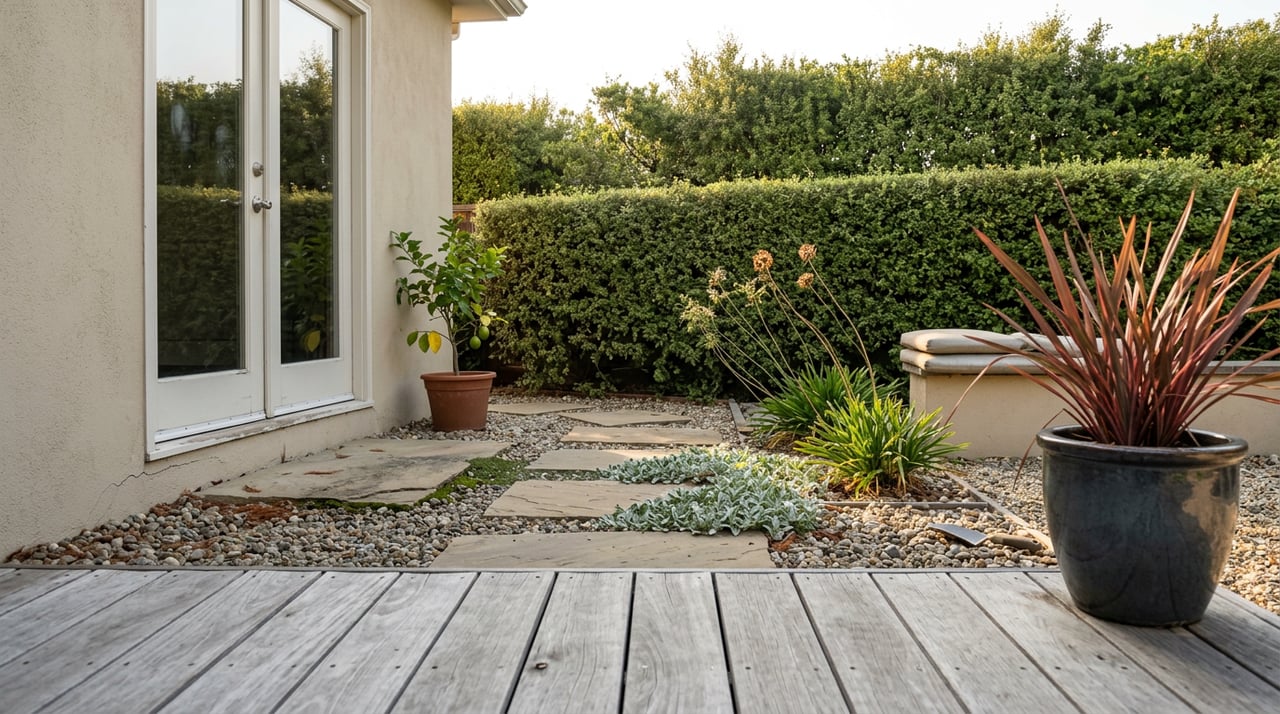
The Line That Actually Decides If Your Capitola House Can Be an Airbnb
Two cottages sit three blocks apart in Capitola. Both are single-family homes, both a short walk from the sand, both listed with photos that lean hard on the word "coastal." One can legally operate as a nightly vacation rental today. The other cannot, not now, not after a remodel, not after a new roof or a fresh coat of sea-glass blue paint. The difference has nothing to do with charm, condition, or distance to the water. It comes down to which side of a specific city boundary each parcel sits on.
That boundary is the reason a buyer shopping for Capitola income property needs to stop asking "is this a vacation town" and start asking "is this specific parcel inside the zone." The city name on the listing tells you almost nothing. The address tells you everything.
Capitola's short-term rental rules run through what the city calls the Vacation Rental Use overlay, or VRU. It is not a percentage cap. It is not a waitlist. It is a drawn line on a map, and the city has published exactly where that line sits: the area consists of Capitola Village, Riverview Avenue as far north as city hall, as far west as Cliff Drive, as far east as Monterey Avenue, and as far south as Capitola Beach.
Inside that boundary, a property owner can apply for a vacation rental permit and business license and, once approved, rent nightly. Outside it, the answer is not "harder" or "eventually." It is simply no. A house one block outside the VRU has the same path to nightly rental income as a house in Scotts Valley, which is to say none, regardless of how the listing agent frames it.
The city has also been explicit about what happens to owners who skip this step. Property owners who rent vacation rentals outside the VRU zone or without proper permits will be ordered to cease their vacation rental operation and may be subject to daily fines if the use continues. Enforcement is not automated. Permit violations are typically enforced by neighbor complaints, and the City of Capitola has been taking inventory of non-compliant vacation rentals using online hosting platforms since June 2015. A neighbor who notices a booking calendar filling up on a house outside the line can file a complaint, and the city does not disclose who filed it.
Here is the part that trips up buyers who find a currently-operating vacation rental and assume the income transfers with the sale. It does not, at least not automatically. The county's own renewal process treats a permit as something tied to active, demonstrated use by the current holder rather than a fixture of the house. County hosted rental renewals require proof of significant use, a summary of the dates the unit was used as a hosted rental, between the time of issuance of the existing permit and the date of renewal, which only makes sense if the permit is understood as belonging to the operator, not the address in perpetuity.
Capitola's published material online does not spell out a separate transfer rule for its VRU permits the way the county spells out renewal proof, and that gap is worth sitting with rather than assuming away. If a seller's disclosure package includes a current vacation rental permit, the smart move is a direct call to Capitola's Community Development Department, at 831-475-7300, before writing an offer that prices in that income as guaranteed to continue under new ownership.
Anyone who researched this a year ago is working from a stale map. The rules governing the unincorporated pockets that neighbor Capitola went through a real overhaul that only became fully effective this year.
"The Santa Cruz County Board of Supervisors unanimously approved new limits on short-term rentals throughout the county on Tuesday, responding to growing concerns that the region was losing housing to platforms like Airbnb and Vrbo."
That vote happened on August 19, 2025, almost exactly a year before this was written. The new framework, formally Ordinance 5497, did not take effect everywhere right away. Portions covering the coastal zone needed sign-off from the California Coastal Commission, and that sign-off did not arrive until this spring. The county's own permit center confirms it directly: the new Short-Term Rental Ordinance was certified by the California Coastal Commission on April 16, 2026, and is now effective throughout the county, with the regulations published as Ordinance 5497.
The substance of that overhaul matters for anyone comparing Capitola to its unincorporated neighbors. The ordinance limits one short-term rental permit per property owner or entity, which shields against the concern that corporations are coming into Santa Cruz County neighborhoods and buying up multiple properties to rent out. That one-per-owner rule did not exist in the old framework and closes off a strategy some investors had been counting on.
"Capitola" and "Santa Cruz County" get used interchangeably in casual conversation about vacation rentals, but they are governed by entirely different bodies with entirely different logic. This is where an out-of-area buyer's assumptions usually break down.
| Where the parcel sits | How eligibility is decided | Status as of mid-2026 |
|---|---|---|
| Capitola, inside the VRU overlay | Fixed geographic boundary. In the zone or not, with no numeric cap | Eligible with permit and business license application |
| Capitola, outside the VRU overlay | Same boundary rule | Not eligible under any circumstance, per current city policy |
| City of Santa Cruz | Owner-occupancy distinction rather than a zone line | The city has not hit its cap on hosted permit rentals; no waitlist currently applies to hosted permits |
| Live Oak Designated Area (LODA), unincorporated county | Percentage cap on parcels and on each block | A maximum of 15 percent of total parcels may hold permits, with a 20 percent per-block restriction, and a waitlist is currently in effect |
| Seacliff/Aptos/La Selva Beach Designated Area (SALSDA) and Davenport/Swanton Designated Area (DASDA) | Same cap-and-block structure as LODA | Also waitlisted under the current framework |
| Non-designated unincorporated county | Countywide numeric cap, one permit per owner | A countywide cap of 270 non-hosted permits applies outside the three designated areas, and existing permits are not revoked |
Six rows, six different answers to what sounds like one question. A buyer who assumes "coastal Santa Cruz County" behaves like a single market is going to misprice the investment before the inspection contingency even comes up.
For a buyer treating a Capitola-area property as an income asset, the due diligence sequence looks different from a standard purchase.
None of this replaces legal advice about a specific parcel. It replaces the habit of shopping a vacation rental by neighborhood reputation instead of by the actual line on the actual map.
If I buy a house inside Capitola's VRU zone, do I get the seller's existing permit automatically? Not necessarily. The county's own renewal process treats permits as tied to demonstrated use by the current holder, and Capitola's public materials do not spell out an automatic transfer at sale. Confirm directly with the city's Community Development Department before assuming the income carries over.
Is there a waitlist to get into Capitola's VRU zone? No, because the VRU is not a numeric cap you queue for. It is a fixed geographic boundary. You are either inside it or you are not, and no waitlist changes that answer.
Does the county's new short-term rental ordinance apply inside Capitola city limits? No. Ordinance 5497 and the countywide 270-permit cap govern unincorporated areas of Santa Cruz County. Capitola, like the City of Santa Cruz, Scotts Valley, and Watsonville, sets its own rules independent of the county framework.
If you are weighing a Capitola-area purchase as an income property, the address deserves the same scrutiny as the comps. Jessyka Sommers has spent years walking these exact boundary lines with buyers who needed a straight answer before they wrote an offer. Let's Connect.

I am committed to guiding you every step of the way—whether you're buying a home, selling a property, or securing a mortgage. Whatever your needs, I've got you covered.
301 Capitola Ave Capitola, CA 95010